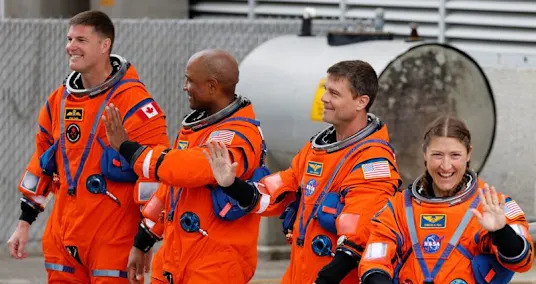
April 1 (Reuters) - All three NASA astronauts on the Artemis II lunar mission are veterans of Earth-orbit science expeditions to the International Space Station, while the lone Canadian joining them on a voyage around the moon and back is a spaceflight rookie.
Here are some highlights from the careers of mission commander Reid Wiseman, pilot Victor Glover and mission specialist Christina Koch, all U.S. astronauts, and Canadian astronaut Jeremy Hansen, also a mission specialist.
MISSION COMMANDER REID WISEMAN
Wiseman, 50, logged 165 days aboard the International Space Station during a 2014 mission, flying to the orbiting platform aboard a Russian Soyuz spacecraft. A former U.S. Navy test pilot, he later served as NASA's chief astronaut before being selected to command Artemis II.
PILOT VICTOR GLOVER
Glover, 49, spent 168 days in orbit beginning in 2020 as pilot of NASA's Crew-1 flight, the first full-fledged ISS mission using SpaceX's Crew Dragon capsule to carry astronauts to the space station. Before joining NASA, he flew more than 40 aircraft during a U.S. Navy career that included combat deployments and test-pilot duties. A veteran of four spacewalks, he is the first Black astronaut ever to be sent on a lunar mission.
MISSION SPECIALIST CHRISTINA KOCH
Koch, 47, set a record in 2019 for the longest continuous spaceflight by a woman, spending 328 days aboard the ISS, and was part of NASA's first three all-female spacewalks. Trained as an electrical engineer and physicist, she previously worked as a NASA engineer and carried out extended research expeditions in Antarctica. She is the first woman to fly on a moon-bound mission.
MISSION SPECIALIST JEREMY HANSEN
Hansen, 50, a Royal Canadian Air Force colonel, is the first Canadian, and first non-U.S. citizen, sent on a lunar mission even as he makes his own first spaceflight. He was selected for Canada's astronaut corps in 2009, and his seat aboard Artemis II reflects a long-standing U.S.–Canadian partnership in human spaceflight, including Canada's contributions to robotics used aboard the ISS.
(Compiled by Joey Roulette in Cape Canaveral, Florida and Steve Gorman in Los Angeles; Editing by Jamie Freed)
LATEST POSTS
- 1
 As tetanus vaccination rates decline, doctors worry about rising case numbers
 - 2Bolsonaro discharged from hospital and placed under house arrest
- 3Baidu robotaxi outage in Wuhan caused by 'system failure', police say
- 4Should you get an RSV vaccine this fall? What to know and where to get a shot
- 5Nurturing Hacks: Astuteness from Experienced Mothers and Fathers





- 6 Fun Urban areas For Seniors To Travel
- Scientists have found an alarming environmental impact of vast data centers
- Michael Jordan donates $10M to North Carolina medical center in honor of his mother
- Old age isn’t a modern phenomenon – many people lived long enough to grow old in the olden days, too
- The 10 Most Progressive Logical Disclosures
- How C-reactive protein outpaced ‘bad’ cholesterol as leading heart disease risk marker
- Russian authorities threaten WhatsApp with total ban
- 'Fertiliser costs mean I'm better off not planting'
- 'We are ready': NASA still on track to launch Artemis 2 astronauts to the moon April 1