When you buy through links on our articles, Future and its syndication partners may earn a commission.

For the first time in more than 50 years, humans are cruising through lunar space.
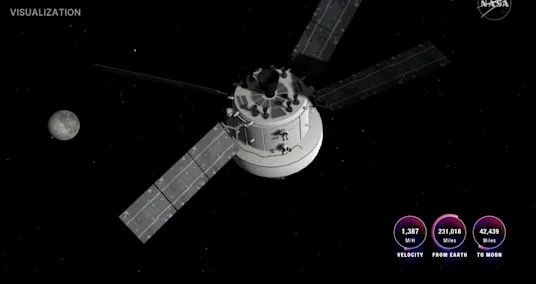
The four astronauts of NASA's Artemis 2 mission arrived in the moon's sphere of influence — the region where lunar gravity exerts a more powerful pull than that of Earth — today (April 6) at 12:37 a.m. EDT (0437 GMT).
The milestone occurred when the mission's Orion capsule was about 39,000 miles (62,764 kilometers) from the moon and roughly 232,000 miles (373,368 km) from Earth, a commentator said during NASA's Artemis 2 livestream.
The Artemis 2 astronauts — NASA's Reid Wiseman, Victor Glover and Christina Koch and the Canadian Space Agency's Jeremy Hansen — are the first people to cross the lunar threshold since December 1972, when the three-person Apollo 17 moon-landing mission did so.
Artemis 2 will not touch down on the moon, or even enter lunar orbit. Rather, Orion will loop around the moon's far side this evening in a history-making flyby. During that encounter, Artemis 2 will get farther from Earth than any crewed flight ever has.
The distance record is currently held by the Apollo 13 astronauts, who got 248,655 miles (400,171 km) from our planet in April 1970. At the height of tonight's flyby, just after 7 p.m. EDT (2300 GMT), Artemis 2 will be 252,757 miles (406,773 km) away from the rest of humanity, NASA officials have said.
The Artemis 2 astronauts will study the moon during the flyby, gathering data that could help scientists better understand the terrain and geology of Earth's nearest neighbor. They'll also be treated to a total solar eclipse, which will not be visible to those of us here on terra firma.
In addition, the flyby will chart their path home: Lunar gravity will slingshot Orion back toward Earth. Artemis 2 astronauts will come home on Friday (April 10), ending their 10-day mission with a parachute-aided splashdown off the coast of San Diego.
Editor's note: This story was updated at 1:15 a.m. EDT on April 6 with NASA's revised time of Orion's entry into the moon's sphere of influence — 12:37 a.m. EDT rather than 12:41 a.m. EDT.
LATEST POSTS
- 1
 Hilary Duff's husband responds to Ashley Tisdale's 'toxic' mom group claims: The drama, explained
 - 215 Preposterous Cosplay Ensembles That Will Blow You Away
- 3Most loved Solace Food: What's Your Definitive Comfortable Dinner?
- 4The Reduced Portage Horse: An Inheritance Reconsidered for Present day Experience
- 5Air New Zealand cuts flights and hikes fares as fuel prices surge





- St George Mining hits record 178m high-grade intercept at Araxá, reinforcing global scale
- Peruvian ex-President Martin Vizcarra sentenced to 14 years in prison
- Holden Commodore Turbo BT1 Police Interceptor Offered for Sale in Australia
- Discussion on deployment of foreign troops ongoing, two sources tell 'Post'
- Figure out How to Protect Your Gold Venture from Unpredictability
- Ukraine: Russians abduct 50 Ukrainians from border village in Sumy
- A Gustav Klimt painting is now the most expensive piece of modern art sold at auction. The fascinating history behind the $236 million 'Portrait of Elisabeth Lederer.'
- Nick Reiner's defense attorney asks to be replaced, again delaying arraignment in connection with the stabbing deaths of his parents, Rob Reiner and Michele Singer Reiner
- Treasure trove found in Egyptian tomb solves ancient mystery